

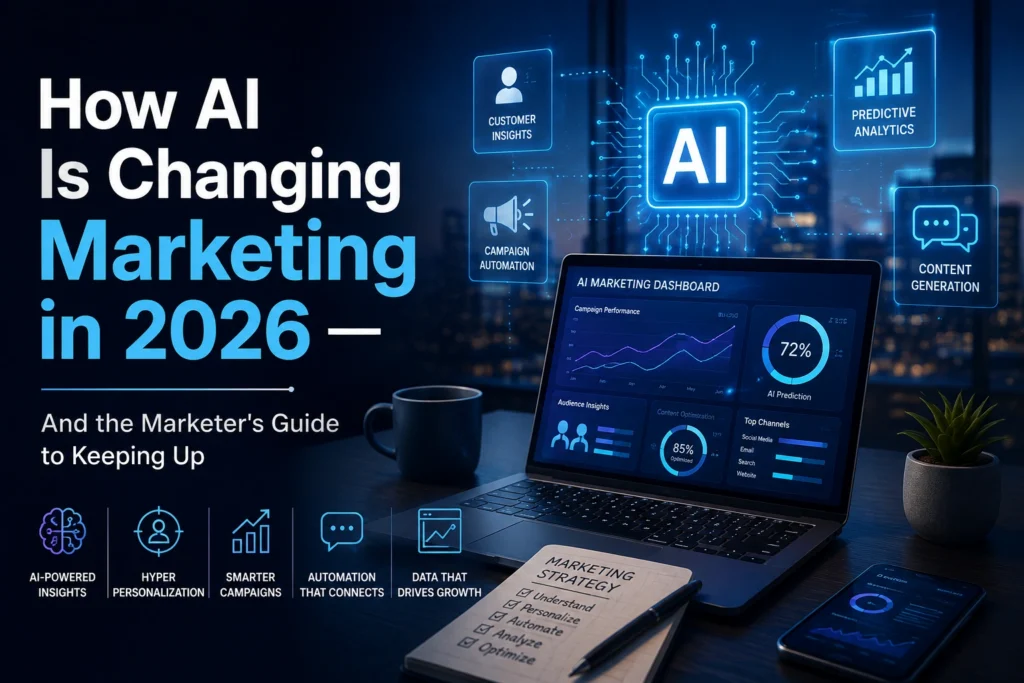
Marketing didn’t just adopt AI, it re-platformed around it in about eighteen months. Here’s what the actual 2026 data says is different, what it means for search and content specifically, and the concrete playbook for what marketers should do next.
The Adoption Curve: From Experiment to Default in Two Years
In Q1 2024, 51% of marketers used generative AI in at least one recurring workflow. One year later that was 76%. By Q1 2026 it had reached 87%, and a separate 1,400-marketer survey from Jasper puts active AI usage at 91%. This isn’t a slow-burn technology adoption curve — it’s the fastest re-tooling of a professional function in recent memory, and it means the question for most marketers is no longer whether to use AI, but whether they’re using it well.
GENERATIVE AI USE IN A RECURRING WORKFLOW, Q1 2024 → Q1 2026 51% → 76% → 87%
MARKETERS ACTIVELY USING AI (JASPER, 2026) 91%
HIGHEST-ADOPTION FUNCTIONS Content marketing 96% · SEO 93% · Demand gen 89%
ADOPTION BY REGION North America 91% · W. Europe 88% · APAC 84% · LatAm 79%
The productivity case is real, not theoretical: nearly half of marketers report saving one to five hours a week since adopting AI tools, and teams that use AI strategically — meaning with defined workflows, not ad hoc prompting — report productivity gains of 44%. That gap between casual and strategic use is the first clue to where this guide is headed.
The Budget Is Bigger Than the Readiness — And That Gap Is the Real Risk
Gartner’s 2026 CMO Spend Survey found that chief marketing officers now allocate an average of 15.3% of their total marketing budget to AI initiatives. Separately, the CMO Survey run by Deloitte, Duke, and the American Marketing Association found generative AI’s share of marketing activity more than tripled, from 7.0% to 22.4%, in just two years. Marketing organizations project that AI will run 55.9% of all marketing activity within three years.
But here’s the number that matters more than any of those: while 70% of CMOs say becoming an AI leader is a critical goal for 2026, only 30% report mature, fully developed AI readiness. Organizations that Gartner classifies as genuinely “AI-ready” invest nearly 50% more of their budget in AI than the average — 21.3% versus 15.3% — which suggests readiness, not enthusiasm, is what actually separates AI spend that pays off from AI spend that’s just cost. Spending on tools without building the workflows, governance, and skills to use them is the single most common way marketing teams waste an AI budget in 2026.
The Bigger Story: AI Has Broken the Old Rules of Search
If there’s one shift marketers cannot afford to treat as optional, it’s this one. Search — the channel that has anchored digital marketing for two decades — now behaves fundamentally differently, and the numbers are stark.
GOOGLE SEARCHES THAT END WITHOUT A CLICK 80%
ZERO-CLICK RATE WHEN AN AI OVERVIEW APPEARS 83% (vs. 60% without one)
ZERO-CLICK RATE INSIDE GOOGLE’S AI MODE 93%
ESTIMATED ORGANIC TRAFFIC LOSS FROM ZERO-CLICK BEHAVIOR 15%–25% (Bain & Company)
Pew Research’s data adds texture to why: users clicked a traditional search result 15% of the time when no AI summary was present, but only 8% of the time when one was — and they clicked a link inside the AI summary itself just 1% of the time. The damage isn’t evenly spread, either. Informational content is hit hardest — health, family, and parenting portals have lost more than 24% of their clicks, and Wikipedia alone is estimated to be losing 31.6 million clicks a month. Transactional searches with clear purchase intent are holding up far better, because people still want to land on the actual page to buy something.
The upside hiding inside the bad news
Traffic that does arrive via AI search converts dramatically better. Similarweb data shows visitors arriving through AI search results convert at more than twice the rate of standard organic visitors, and one industry analysis puts AI referral conversion at 14.2% against 2.8% for traditional Google organic traffic — a five-times gap. Fewer visitors, much higher intent: that’s the trade AI search is making on marketers’ behalf, whether they’ve planned for it or not.
GEO and AEO: The New Discipline Sitting on Top of SEO
Two acronyms have moved from niche to essential in the last year. Generative Engine Optimization (GEO) is the practice of structuring content and brand presence so that AI systems — ChatGPT, Perplexity, Google’s AI Overviews, Claude — cite and recommend a brand inside their generated answers, rather than simply ranking a link on a results page. Answer Engine Optimization (AEO), which originally targeted voice search and featured snippets, has largely been absorbed into GEO, since most voice and snippet queries now route through the same generative systems.
The critical thing for marketers to understand is that GEO does not replace SEO — it sits on top of it. The brands succeeding at GEO in 2026 are, almost without exception, the same brands with strong existing SEO foundations: clean structured data, clear factual claims, credible third-party citations, and content that directly and unambiguously answers a specific question. AI systems cite sources they can verify quickly; ambiguous, keyword-stuffed, SEO-only content is exactly what generative engines are trained to skip over.
CHATGPT WEEKLY ACTIVE USERS (MARCH 2026) 900 million+
SHARE OF ALL GOOGLE SEARCHES SHOWING AN AI OVERVIEW 25%+
US POPULATION PROJECTED TO USE GENERATIVE AI SEARCH IN 2026 31.3% (EMARKETER)
Personalization Has Moved From Segments to Individual Agents
The other structural shift is in how brands target and personalize. Agentic AI — AI systems that can take multi-step action on their own, not just generate text — is enabling personalization at the individual level in real time, replacing the batch-and-blast segment model that has defined digital marketing since the 2000s. Academic case studies covering Coca-Cola, Netflix, and Unilever document how agentic systems are being used to adapt messaging, offers, and creative in real time per customer, rather than per segment.
The commercial case is measurable: shoppers who engage with an AI shopping assistant convert at four times the rate of those who browse unassisted. Adobe’s own internal B2B marketing team has moved away from linear, manually scored leads toward AI systems that analyze engagement patterns across entire buying groups to identify genuine intent — a meaningfully more sophisticated read on purchase readiness than a single lead score. None of this is free of risk, though: every credible framework for deploying agentic personalization at scale specifies the same guardrails — clearly defined brand policies, structured human review points, audit documentation, and escalation protocols for anything the AI shouldn’t decide alone.
What Marketers Should Actually Do About All of This
Adoption is no longer the differentiator — 87% of the industry has already cleared that bar. The gap that actually separates teams now is training, judgment, and workflow design. That gap is wide: 87% of marketers use generative AI in a recurring workflow, but only 17% have received any formal training on how to use it well. That mismatch is where most of the wasted AI budget, generic AI-sounding content, and stalled ROI in 2026 is coming from. Here’s the practical response, based on where the data points.
- Build for citation, not just ranking
Audit your highest-value content for GEO readiness, not just keyword targeting: does it state facts clearly and verifiably, cite credible sources, use structured data, and directly answer the exact question a searcher — human or AI — is asking? If an AI system can’t quickly verify and quote your page, it will cite a competitor instead.
- Re-weight investment toward transactional and branded search
Since zero-click loss concentrates in informational queries and spares transactional ones, teams over-indexed on top-of-funnel content should rebalance investment toward content and pages that support purchase-intent and branded search, where AI Overviews cause the least damage and conversion rates are healthiest.
- Treat AI referral traffic as a distinct, high-value channel
With AI-referred visitors converting two to five times better than standard organic traffic, they deserve their own tracking, attribution, and reporting line — not a footnote inside “organic search” — so leadership can see the shift in channel value clearly.
- Close the training gap before adding more tools
With adoption at 87% but formal training at just 17%, the highest-leverage move for most marketing leaders in 2026 isn’t buying another AI tool — it’s building structured training and internal workflow standards for the tools already in use. Budget follows readiness, not the other way around, per Gartner’s own data on AI-ready teams outspending and out-returning the average.
- Build the human judgment layer explicitly into workflows
The most valuable marketing skill in the AI era isn’t prompting — it’s editorial judgment: recognizing when AI output is factually shaky, off-brand, generic, or subtly wrong, and fixing it before it ships. Formalize this as a review step, not an assumption that someone will catch it.
- Put governance around agentic and personalization systems now, not after an incident
Any team deploying AI-driven personalization or agentic workflows should have documented brand guidelines for the AI, defined human checkpoints for high-stakes decisions, and an audit trail — before scaling, not as a retrofit after something goes wrong publicly.
The Bottom Line
AI in marketing stopped being a pilot project years before most organizations updated their strategy to reflect it. The technology adoption curve is essentially finished — 87 to 91% of marketers are already using it. What’s unfinished is the harder part: rebuilding search strategy around a world where four out of five queries never produce a click, building content that AI systems trust enough to cite, and closing a training gap that’s five times wider than the adoption gap ever was. The marketers who treat 2026 as the year they operationalized AI, rather than the year they merely adopted it, are the ones who’ll show up in next year’s budget data as the 21%-of-spend AI leaders — not the 70% still saying it’s a priority.
Sources: Jasper 2026 State of AI in Marketing; Gartner 2026 CMO Spend Survey; The CMO Survey (Deloitte, Duke University, American Marketing Association); Pew Research Center; Bain & Company; Similarweb; EMARKETER; Search Engine Land; MarTech.org. Compiled August 2026.
The Best Hotels in India — And the Real Reasons They’re Ranked There