

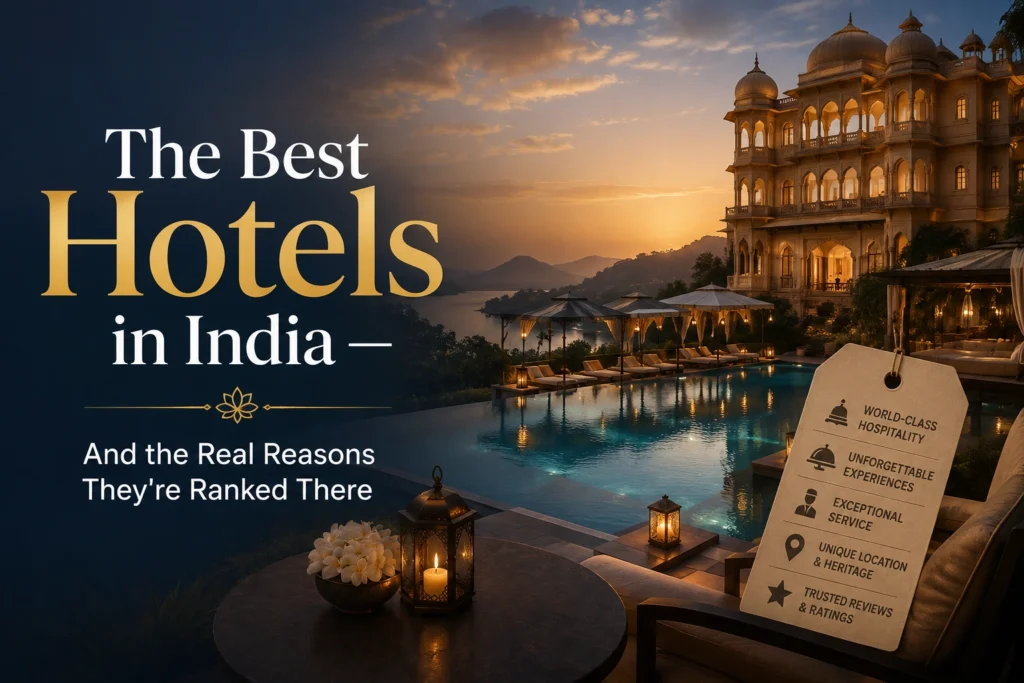
India’s luxury hospitality scene is dominated by a handful of names that keep winning, year after year, across completely different judging panels. This is a look at who’s actually on top in 2025–26, according to the organizations that rank them, and what specifically earns each property its place.
Rankings and figures below are drawn from Travel + Leisure’s World’s Best Awards 2025, The World’s 50 Best Hotels 2025, Condé Nast Traveler’s Readers’ Choice Awards, Forbes Travel Guide, the Michelin Guide, and each property’s own verified press materials, current as of August 2026.
How “Best” Actually Gets Measured
Before ranking anything, it’s worth knowing who’s doing the ranking — because India’s top hotels don’t win one award, they win several different kinds, each measuring something different.
- The World’s 50 Best Hotels — voted by an international panel of travel experts; extremely selective, only one Indian hotel currently sits in the global top 50.
- Travel + Leisure World’s Best Awards — a large-scale reader survey scoring rooms, service, location, food, and value; this is where Indian hotels tend to sweep entire categories.
- Condé Nast Traveler Readers’ Choice Awards — another reader-voted award, historically the one that has crowned Indian palace hotels as the literal “World’s Best Hotel.”
- Forbes Travel Guide stars and Michelin Keys — the two ratings systems built on anonymous, professional inspection rather than public voting, and considered the hardest to earn.
A hotel that shows up across all five isn’t winning a popularity contest once — it’s converting completely different audiences (readers, professional inspectors, and expert panels) using completely different criteria. That’s the real signal.
The Taj Mahal Palace, Mumbai — India’s Only Global Top-50 Hotel
WORLD’S 50 BEST HOTELS 2025 No. 38 globally — the only Indian hotel in the top 50
FORBES TRAVEL GUIDE 2025 Four Stars
MICHELIN GUIDE 2025 1 Key
OPENED 1903
This is the property every other Indian hotel is implicitly measured against. Built by industrialist Jamsetji Tata as India’s first Indian-owned luxury hotel, its 240-foot Florentine dome overlooking the Gateway of India has made it a Mumbai landmark for over 120 years, blending Indian, Moorish, Oriental, and Renaissance architectural influences into one building. It is currently the only Indian hotel ranked in the global top 50 by The World’s 50 Best Hotels — a list built on international peer voting, not public reviews, which is what makes that single placement disproportionately significant. It also picked up Forbes Travel Guide’s Four Star rating and a Michelin Key in 2025, plus recognition for its spa at the Vogue Wellness & Beauty Awards — evidence that its reputation extends well past the lobby and into service depth across the property.
The Oberoi Sweep: Four Resorts, Four of the Top Four Spots in India
In the Travel + Leisure World’s Best Awards 2025, Oberoi Hotels & Resorts didn’t just win — it took every one of the top four positions in the India category with four different properties, and the brand itself was ranked the #2 hotel brand in the world.
#1 INDIA — THE OBEROI AMARVILAS, AGRA Travel + Leisure Hall of Fame
#2 INDIA — THE OBEROI RAJVILAS, JAIPUR Villas with private pools
#3 INDIA — THE OBEROI VANYAVILAS, RANTHAMBHORE Luxury tented wildlife resort
#4 INDIA — THE OBEROI UDAIVILAS, UDAIPUR Lakeside palace-style resort
OBEROI HOTELS & RESORTS #2 Best Hotel Brand in the World, T+L 2025
The Oberoi Amarvilas earns its top spot on nothing but location and restraint: every one of its rooms and its infinity pool face the Taj Mahal directly, a half-mile away, and the hotel has held its spot in Travel + Leisure’s Hall of Fame — reserved for hotels that don’t just win once but stay ranked among the world’s best for years running. What ties all four Oberoi properties together isn’t the buildings, which range from a Mughal-inspired palace to a wildlife-reserve tented camp — it’s a single, consistently drilled service philosophy the group has run since its founding, which the Oberoi leadership itself describes as measuring success by “the value of the human interaction,” not the physical property. That consistency is precisely why a reader-voted award — where guests are scoring their actual experience, not a building — rewards four different Oberoi hotels in four different cities the same way.
Taj Lake Palace, Udaipur — The Most Photographed Hotel in the World
Floating in the middle of Lake Pichola, this 275-year-old former royal summer palace routinely gets called the most photographed hotel on Earth, and it isn’t hyperbole — the white marble palace appears to rise directly out of the water with no visible shoreline in most shots. It ranked #1 in India in Condé Nast Traveler’s Readers’ Choice Awards’ Top 15 Hotels in India list, and it’s the kind of property where the architecture itself does most of the marketing: guests arrive by private boat, and the hotel has no land-based entrance at all. This is heritage hospitality where the physical scarcity — there is only one lake, and only one palace on it — does the differentiation work that no amount of service polish could replicate elsewhere.
Rambagh Palace, Jaipur — From Royal Residence to World’s No. 1
Once the residence of the Maharaja of Jaipur, Rambagh Palace was rated the World’s No. 1 Hotel by TripAdvisor’s Travellers’ Choice Awards in 2023 and continues to sit at #2 in India on Condé Nast Traveler’s reader rankings. Its edge is authenticity that can’t be manufactured: original royal suites, resident peacocks on manicured lawns, and a still-functioning polo bar that was once the private domain of the Jaipur royal family. Where newer luxury hotels have to build a story, Rambagh Palace only has to preserve one — and that’s a meaningfully different (and cheaper) kind of brand-building.
Umaid Bhawan Palace, Jodhpur — Still a Working Royal Residence
Umaid Bhawan Palace is one of the largest private residences in the world, and unlike most heritage hotels, part of it is still the actual home of the Jodhpur royal family — guests are staying inside a functioning palace, not a museum piece converted for tourism. It has been named the World’s Best Hotel outright by Condé Nast Traveler’s Readers’ Choice Awards, the same award category that has repeatedly gone to Indian palace properties over international competition. The building itself, a 1943 Art Deco sandstone palace commissioned to provide famine relief employment, is a genuine architectural rarity — there is no comparable structure anywhere else in the world, which is a difficult thing for any competitor to out-build.
ITC Hotels — Winning on a Completely Different Axis: Sustainability
LEED PLATINUM CERTIFIED PROPERTIES 23 — the most of any hotel company worldwide
LEED ZERO CARBON CERTIFIED First 12 hotels in the world
LEED ZERO WATER CERTIFIED First 11 hotels in the world
WORLD SUSTAINABLE TRAVEL & HOSPITALITY AWARDS 2025 World’s Leading Sustainable Organisation
ITC Hotels doesn’t compete for the same “most beautiful palace” story as Taj or Oberoi — it has built an entirely separate case for being “top,” under a philosophy it calls Responsible Luxury. ITC Maurya in Delhi was the world’s first LEED Platinum hotel under the Existing Buildings category, and the group now holds more LEED Platinum certifications than any hotel company on Earth. This matters commercially, not just environmentally: as corporate travel policies and conscious younger travelers increasingly screen for sustainability credentials before booking, ITC has effectively built a moat that heritage architecture alone can’t replicate — you can’t retrofit a 1903 palace to out-green a hotel engineered for net-zero from the ground up.
The New Guard: Design-Led Boutique Hotels Are Starting to Break Through
The World’s 50 Best Hotels released its first-ever extended list (ranking positions 51 to 100) in 2025, and two independent Indian boutique properties made the cut: The Johri, a small heritage hotel inside Jaipur’s Pink City walking distance from Hawa Mahal, and Amanbagh, the Aman group’s Rajasthan retreat. Neither has the scale or the family legacy of a Taj, Oberoi, or Umaid Bhawan — what’s getting them recognized instead is design intensity and extreme guest-to-space ratio, the same formula that built Aman’s global reputation. Their appearance on a global list, even in the extended 51–100 range, signals that India’s luxury hotel story is no longer only about restored palaces; it’s starting to include hotels built from scratch to compete globally on design alone.
What Actually Puts a Hotel “On Top” — The Pattern Across All of Them
Strip away the individual stories and four factors repeat across every hotel on this list:
- Physical scarcity that can’t be copied — a lake with one palace on it, a wildlife reserve, direct sightlines to the Taj Mahal. Location, in the literal sense, is still undefeated as a competitive moat.
- A service philosophy applied consistently across multiple properties — the reason Oberoi can win four separate India rankings with four different buildings is that the training and standards, not the architecture, are the actual product.
- Authenticity that doesn’t need to be invented — Rambagh Palace and Umaid Bhawan aren’t performing “heritage,” they still function as royal residences, which reader-voted awards consistently reward over polished reproductions.
- A genuinely different axis of competition — ITC didn’t try to out-palace the palaces; it built an entirely separate, defensible claim to leadership through sustainability credentials that are difficult and slow for anyone else to replicate.
The common thread is that none of these hotels are “on top” by accident or by marketing spend alone. Each one either owns something physically irreplaceable, or has industrialized a standard of service and consistency that a single beautiful building can’t deliver on its own.
Sources: Travel + Leisure World’s Best Awards 2025 (oberoihotels.com); The World’s 50 Best Hotels 2025 (theworlds50best.com); Condé Nast Traveler Readers’ Choice Awards (ihcltata.com); Forbes Travel Guide & Michelin Guide 2025 coverage (travelandtourworld.com); ITC Hotels sustainability disclosures (itchotels.com, wstha.com). Compiled August 2026.