
TVW NEWS INDIA, Media & Marketing Desk · August 17, 2026 – NDTV 24×7 has become simply NDTV. A look at why organisations retire the names they built — with the costs, failures and rare successes on record.
The trigger: NDTV drops the ’24×7′
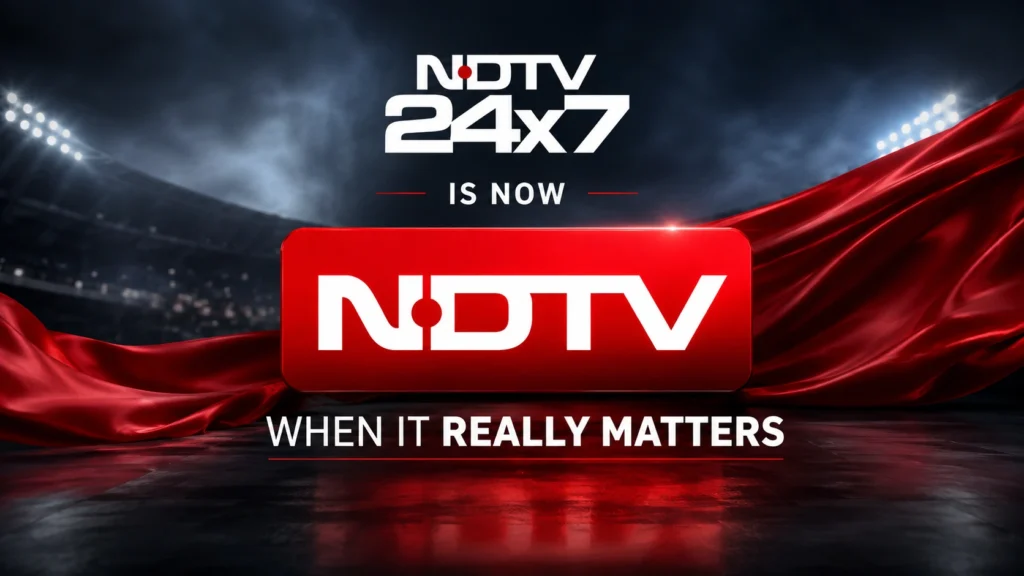
On August 15, 2026, NDTV 24×7 became NDTV. The channel unveiled a new identity anchored in the line “When It Really Matters,” retiring a suffix it had carried for close to three decades. The change is being pitched not as a cosmetic logo swap but as a consolidation: television, website, app, social platforms, streaming and Connected TV will now sit under one brand name instead of the channel-specific “24×7” tag.
“At a time when news is often obscured by competing chaos, ‘When It Really Matters’ gives us a clear editorial compass. It is a reminder to separate what commands attention from what carries genuine significance.” — Shiv Aroor, Managing Editor, NDTV
There is a quiet irony worth noting for readers of a media trade desk: NDTV itself was the joint-venture partner that helped launch Star News in 1998, a channel that was later renamed ABP News in 2012 after ownership rules forced a split. Name changes are not new to Indian television — NDTV’s own 2026 rebrand is simply the newest entry in a list its own history intersects with.
Why brands rebrand: the taxonomy
Strip away the press releases and most rebrands fall into a handful of recurring categories. None of them are really about a new logo — the logo is just the visible tip of a decision made elsewhere in the business.
- Consolidation across platforms — a name built for one medium (a 24-hour TV feed) stops matching how people actually consume the product (app notifications, YouTube clips, WhatsApp forwards). NDTV’s 2026 change and, arguably, Google folding products under one identity fit here.
- Ownership or merger change — when two companies combine or a new owner takes over, the old name often can’t survive the cap table. Vodafone Idea became Vi in 2020 after its 2018 merger; Air India got a new FutureBrand identity in 2023 after the Tata Group took the airline back from the government.
- Regulatory or legal compulsion — sometimes the name isn’t a choice. Star News became ABP News in 2012 because India’s 26% foreign ownership cap on news channels made the Star licensing arrangement untenable.
- Reputation repair — a name gets so tied to a scandal, a bankruptcy, or a public failure that continuing to use it costs more than replacing it (classic examples outside India include Philip Morris becoming Altria, and Blackwater’s multiple renamings after controversy).
- Strategic pivot or bet on the future — Facebook renamed its parent company Meta in 2021 to signal a shift toward the metaverse, well before the product existed at scale.
- Founder or leadership change of direction — Twitter’s 2023 rebrand to X under new ownership was framed as building an “everything app,” not just a name change.
The analogy: a name is a lease, not a deed
The clearest way to think about rebranding is that a brand name is a lease on public attention, not a deed of permanent ownership. A company earns the right to a name through years of consistent behaviour — the way a tenant earns a landlord’s trust. But leases have terms. When the business inside the name changes enough — a merger, a new medium, a new owner, a new promise — the old lease stops covering what’s actually happening inside the building, and the sign outside has to be repainted to match.
This is also why the analogy of a person’s name change works only partway. A person changing their name is usually announcing something has already changed internally. A corporate rebrand is riskier than that, because the audience’s trust was attached to the old name specifically — not to the company behind it. That is the entire reason Gap’s 2010 logo change and Tropicana’s 2009 packaging redesign failed within days and weeks respectively: customers had built muscle memory around a specific visual sign, and the company changed the sign faster than it could re-teach the audience to trust the new one.
The numbers: what rebrands actually cost, and what they return
Industry estimates put a straightforward corporate rebrand — new name, logo, guidelines, and rollout across collateral — anywhere from $10,000 for a small business to $250,000–$1,000,000+ for an established enterprise, typically spread over eight to ten months. Most companies allocate 10–20% of their annual marketing budget to the exercise. When it works, agencies cite returns as high as 2,000–3,500% ROI over three years, largely from renewed customer attention and internal alignment rather than the logo itself. When it doesn’t work, the numbers run the other way just as fast, as the case list below shows.
| Rebrand | Year | Numbers on record | Verdict |
|---|---|---|---|
| Gap → new wordmark logo | 2010 | ~$100 million logo/campaign spend; reverted after 6 days amid 2,000+ complaints in 24 hours | Failed |
| Tropicana Pure Premium packaging | 2009 | $35M ad spend on new look; sales fell 20% in 2 months, a ~$30M loss; old pack restored within weeks | Failed |
| Facebook → Meta | 2021 | Trademark buyout alone reported near $20M; Reality Labs (the bet behind the name) has since lost over $70B | Mixed / costly |
| Twitter → X | 2023 | Brand value fell from ~$5.7B (2022) to ~$3.9B (2023) to about $673M by 2024, per Brand Finance | Failed so far |
| Vodafone Idea → Vi | 2020 | Merger-driven; came alongside a Rs 50,000 crore AGR dues order and multi-thousand-crore fundraising | Mixed |
| Air India (Tata takeover) | 2023 | New FutureBrand identity; cabin refresh alone budgeted near $400M across 43 wide-bodies | In progress |
| ANZ Bank logo | 2010–12 | Reported $15M logo and identity spend over a 2-year campaign | Neutral |
| BBC logo | — | Reported $1.8M logo cost | Neutral |
| Star News → ABP News (India) | 2012 | Forced by FDI rules capping foreign ownership at 26%; ABP took full control of the channel brand | Successful |
| NDTV 24×7 → NDTV | 2026 | No cost disclosed; positioned as identity unification across TV, web, app, social and CTV | Too early to call |
What the data actually teaches
Three patterns hold across every case in that list, successful or not.
- Rebrands that follow a real structural change — a merger, an ownership transfer, a regulatory order, a shift in how the audience already consumes the product — tend to be judged more kindly, even if the new name takes years to feel natural (Vi, ABP News, Air India).
- Rebrands that ask the audience to feel differently about an unchanged product, purely on the strength of a new visual identity, are the ones that collapse fastest — Gap in 6 days, Tropicana in about 2 months.
- Platform and social-media rebrands carry a specific extra risk: the brand value is stored in the habit of saying the name out loud (“tweet,” “Google it”). X has struggled since 2023 precisely because a two-decade-old verb doesn’t disappear on command — two years on, a majority of Americans surveyed still call it Twitter.
Where NDTV’s move sits on that map
By its own framing, the NDTV 24×7-to-NDTV change belongs in the first, lower-risk category: it follows an already-completed shift in audience behaviour (news consumed across app, web, social and CTV rather than a single 24-hour feed) rather than trying to manufacture a new feeling around an unchanged product. No rebrand cost has been disclosed publicly for the exercise, and the channel’s own reporting frames it as identity unification rather than a reputational reset. Whether “When It Really Matters” becomes a durable positioning line or a forgotten tagline will likely be decided less by the logo and more by whether NDTV’s daily output over the next year matches the promise attached to the new name — which, per every case above, is the part that was never really about the logo in the first place.
Sources
Marketing Mind, Afaqs, Medianews4u, BestMediaInfo, Indian Broadcasting World, MediaBrief, Adgully and Social News XYZ — NDTV 24×7 to NDTV rebrand coverage, August 2026.
Business Standard, BestMediaInfo — Star News to ABP News, 2012.
Scroll.in, DNA India, Gulf News, Wikipedia — Vodafone Idea to Vi, 2020.
Outlook Business, Business Today, Air India Newsroom, Flightradar24 — Air India rebrand, 2023.
The Branding Journal, Packaging Digest, Depix, Smashbrand — Tropicana 2009 packaging redesign.
DesignRush, Startup Stash, The Branding Journal, Avanza Branding Agency — Gap 2010 logo redesign.
Time, Brand Finance, Forbes, Fortune — Twitter to X rebrand and brand value, 2023–2024.
AppleInsider, Diply, Yahoo Finance, Fortune — Facebook to Meta rebrand and costs, 2021–2025.
Sortlist, Frontify, Hivemind, OfSpace, Alden Marketing — rebranding cost and ROI benchmarks, 2024–2026.