
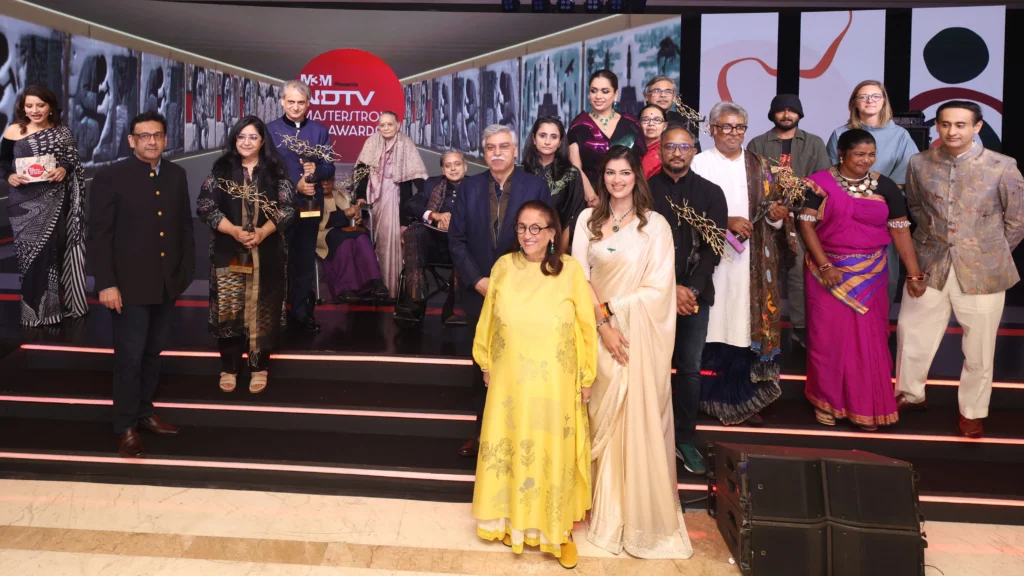
Walking into the inaugural NDTV Masterstroke Art Awards, one did not get the impression of entering ‘yet another’ awards ceremony. The setting and the tone of the conversations suggested something closer to a carefully curated art exhibition – crafted to make art feel accessible, personal.
The interactions among those present unfolded in an easy, unforced manner. Conversations flowed seamlessly among artists, patrons, curators, and guests, without any visible hierarchy or exclusivity. People reflected a shared interest, a collective pursuit to democratize art – the very purpose of the Masterstroke Art Awards.
The awards reflected this purpose by recognizing a broad spectrum of contributors to India’s art world – artists, patrons, institutions, writers, and curators – acknowledging that art does not exist in isolation but within a larger ecosystem that sustains it.
Reflecting on the idea of NDTV Masterstroke Art Awards, Rahul Kanwal, CEO and Editor-in-Chief, NDTV, said: ‘NDTV is widely recognized for its engagement with politics, markets, and public affairs, but culture is equally central to how a society understands itself. With the Masterstroke Art Awards, we wanted to create a space where art is not treated as a niche interest but as part of mainstream public life. We intend to give it greater visibility, respect, and presence in everyday conversation, so that more people feel invited to engage with it rather than keeping it confined to exclusive circles. The winners of the inaugural Masterstroke Art Awards echo the same spirit. ’
Arpita Singh, named Artist of the Year, was honored for a body of work that has consistently engaged with lived realities – memory, emotion, politics, and identity, in ways that resonate beyond gallery walls.
The Lifetime Achievement in Art Award to Krishen Khanna acknowledged decades of artistic practice intertwined with deep intellectual engagement in India’s cultural life, recognizing not only his paintings but his role in shaping conversations around art and society.
Vikrant Bhise, awarded Emerging Artist of the Year, represented a younger generation of artists still shaping their visual language – experimental, reflective, and rooted in personal and social narratives.
Kiran Nadar, honored as Art Patron of the Year, was recognized for her sustained contribution to India’s cultural infrastructure – through museums, philanthropy, and long-term institutional support – aligning closely with the evening’s emphasis on making art more accessible to a wider public.
The Excellence in Traditional Arts Award to Mangla Bai broadened the frame beyond urban galleries, highlighting the importance of living indigenous traditions in India’s artistic heritage. In a similar vein, the recognition of the Panjeri Artists Union with the Art for Impact – Social Change Award emphasized that art can function as a vehicle for community, identity, and collective expression, not merely aesthetic appreciation.
Among institutions, Serendipity Arts Foundation was honored for creating platforms that encourage dialogue and engagement with art. DAG received the Gallery of the Year Award for its sustained commitment to research, documentation, and scholarship. The Museum of Art & Photography in Bengaluru was recognized as Museum of the Year for reshaping how Indian art is archived, interpreted, and made accessible to broader audiences.
The awards also acknowledged those who shape how art is understood. Vandana Kalra was named Art Writer of the Year, reaffirming the importance of critical discourse in the cultural ecosystem. The book Madhvi Parekh: Early Drawings, published by DAG, won Art Book of the Year, underscoring the value of documentation and scholarship in preserving artistic legacy.
Roobina Karode’s recognition as Curator of the Year highlighted the often-invisible role curators play in shaping how audiences encounter art. The Global Cultural Icon Award to Annie Leibovitz brought an international dimension to the evening, while the Public Art Installation Award to Partha Dasgupta reinforced the idea that art ultimately belongs in shared public spaces, not only within gallery walls.
The selections were made by a jury chaired by Kiran Nadar, philanthropist and founder of the Kiran Nadar Museum of Art. Alongside her sat Akshata Murty, entrepreneur and cultural philanthropist; Anjolie Ela Menon, one of India’s most respected contemporary artists; Dr. Pheroza J. Godrej, a longstanding art patron; Abhishek Poddar, Founder and Chairperson of the Museum of Art & Photography, Bengaluru; Kishore Singh, author and cultural commentator; Sabyasachi Mukherjee, designer and creative entrepreneur; Sandy Angus, Founder and Director of the India Art Fair; Shanay Jhaveri, Curator and Programme Director at London’s Barbican Centre; Ibrahim Mahama, internationally acclaimed contemporary artist; and Dr. Payal Kanodia, Chairperson and Trustee of the M3M Foundation. Their collective presence brought together artistic, curatorial, institutional, and global perspectives.
Rohit Chawla, Creative Director, NDTV, explained the conceptual approach behind the evening:
‘From the outset, we did not want this to feel like a conventional awards show. The larger aim was to remove the invisible barriers that often make art feel intimidating or elite, and instead create an environment where artists, institutions, and audiences could come together naturally, with mutual respect.’
The inaugural NDTV Masterstroke Art Awards imagined art in a more visible, more inclusive place within public life – a first step toward making art a more democratic part of a new India’s cultural conversation, its artistic being and becoming.